23.3.22

Sorrow Gothic: Thoughts on a Goth/Gothic Revival


Introduction

The Gothic is undead; long live the Gothic.

It’s been roughly 40 years since the Gothic genre was rejuvenated – after decades on the relative sidelines of mainstream attention – by the fresh blood of a new musical style and the community that grew out of it. A concept, a mood, a method, an aesthetic; however defined, the Gothic was pulled from the bookshelf, dusted, and set to a soundtrack that gave birth to a Goth subculture that has ebbed and flowed over the decades, but has so far resisted being fully staked by changing tastes.

However…

… the dead may travel fast, but even they must slow down eventually. And so, years after Goth’s heyday, we find the number of nightclubs greatly diminished, legendary stores (like Toronto’s Siren) shuttered, and leading magazines out of print. Even Hot Topic, contentious among Goths for its commercialism but somewhate underappreciated for its efforts to celebrate alternative music and subcultures, has shed much of its counter-culture charm by embracing pop-culture franchises. New bands do emerge, of course, and a few dedicated Goth/Punk/Alternative retailers like Tripp NYC, Lip Service, Heavy Red, and others remain to leverage the Internet to cater to an international clientele. Yet for the most part Goth has become stagnant for a number of reasons: aging demographics; trends in youth culture; the diminishing popularity of Goth’s parent genre, rock, in favour of hip hop and new country; and the niche status of its muse, Gothic literature, at least in its classic form.

Another reason for Goth’s apparent stagnation arises from the nature of group dynamics. Open arms and lack of authority has made the culture wonderfully decentralized, organic, and welcoming to social “misfits,” but its vague definition all-too-easily reduces to style over substance. As the old saw would have it, we don’t always know what Goth is, but we know it when we see it. The consequence is that, like almost anything, Goth’s original expression has been diluted by variations over the years, some relevant, others tangential at best, and still others irrelevant. (Illustrator Trellia demonstrates with a none-too-serious classification of Goth stereotypes at DeviantArt). Without some sort of impartial reference, overly personal definitions sometimes become exclusionary gestures in communal settings (e.g. the curious gother-than-thou snobbery), which hardly fosters a sustainable cultural identity. It doesn’t help that Goth is easily caricatured by both the sympathetic and unsympathetic.

As for the Gothic in literature and other media, we could debate to what extent it really is marginal. With its decayed architecture, gloomy landscapes, and Victorian sensibilities, Classical Gothic memorably appears from time to time in films like Crimson Peak and Sleepy Hollow but is otherwise a rare beast in today’s menagerie of genres. As a general influence, however, the Gothic continues to exert pressure on modern genre variations such as Southern Gothic as well as contemporary horror, albeit in the crude sense that the Gothic is often used interchangeably with the supernatural and lurid.

What can be done to invigorate a near-moribund genre and its supportive subculture? It would be too much to suggest a restoration of old regimes cleansed of their shortcomings and polished for the 21st century; the past can’t be repeated. A revolutionary reinvention would present another kind of problem, namely, that of straying out of the Gothic altogether. The question, then, is what sort of evolutionary gesture can we propose?

To answer the question, it’s necessary to trace what we might call the Gothic Idea – the unifying thread between the Gothic from architecture through music and culture.


The Gothic Idea A Brief History

Architecture

“Gothic” was not the given name of the architectural style that expanded the Romanesque design philosophy. As a pejorative invoking the barbarian hordes, the label was used as a shorthand criticism of Middle Age architecture by later Renaissance architects and critics who viewed their own neo-classical approach as a superior and refined expression of civilization. The label stuck, mostly without its negative connotation, and it continues to describe a singularly unique architectural design philosophy.

Unlike Romanesque buildings that feature a denser massing of building forms, simple ornamentation, and details such as rounded arches, Gothic buildings use innovative structural elements such as flying buttresses and a highly ornamental design vocabulary including pointed arches, stained glass windows, and ornate facades. It’s no surprise that our overall experience of Romanesque and Gothic buildings is quite different, and it is in this difference that the Gothic Idea emerges. Where Romanesque conveys a fortress-like impression, the Gothic uses space, light, and highly artistic ornamentation to create an expansive experience. If we feel small in a Gothic volume, it’s typically because we are small. When that feeling of smallness is contextualized by architectural and artistic elements, it becomes, to the sympathetic, an experience we could provisional label as “awe;” beautiful yet terrifying, comforting yet alienating, sacred but fully aware of the profane. This last quality is particularly noteworthy, because it points to why Gothic architecture can be judged as both beautiful and grotesque/ugly: it formally acknowledges the brutish aspects of living that later renaissance styles suppressed in the pursuit of a bright, refined aesthetic (i.e. a purified beauty).Of course, a Gothic cathedral’s ecclesiastical function purposely interprets awe as an encounter with divinity. The architecture shapes the congregant e
xperience to connect with the Church and with the divine. But it isn’t necessary for the meaning of this experience to be religious, as demonstrated by the use of Gothic architecture in the academic realm. Here, the experience of awe is not that associated with encountering the divine, but with our encounters with the mysteries of the universe.

The Gothic in architecture, then, can be described as using the built environment, though a specific design vocabulary, to elicit an experience of awe (religious or secular), which we might also refer to as the uncanny or the sublime.

Literature
 

Unlike the ambiguity of architectural experience, the clearest – although by no means absolute – articulation of the Gothic Idea comes from Gothic literature. Scholars generally point to Horace Walpole’s The Castle of Otranto, published in 1764, as the first definitive Gothic novel, but textual elements as well as the author’s admitted indebtedness to Shakespeare makes a case that the Gothic originated, in prototypical form, with Hamlet. Walpole’s innovation was to take elements of Hamlet such as the ghost and medieval setting, and heighten them with terror in a narrative that blends the fantastical with romance. Firmly establishing what later became genre tropes, we find in the novel gloomy medieval buildings, dark passages, secrets and mysteries, supernatural phenomena, lingering menace, and a sense of foreboding and mystery. These DNA molecules positioned The Castle of Otranto as the genetic ancestor from which the Gothic genre evolved and splintered. 
 
Following Walpole, and surpassing him, were two authors whose prominence marked a split in the nascent Gothic genre. The first was Ann Radcliffe, a literate genre innovator who proved a popular and respected novelist in her time with six Gothic novels, a book of poetry, and a travelogue to her credit. Her work, as exemplified by Romance of the Forest, The Mysteries of Udolpho, and The Italian, was notable for its romanticism, evocative (if lengthy) descriptions of nature, and gothic plot elements involving a vulnerable heroine, menacing villain, and remote castle setting. The supernatural played a part in her novels as well, but in the form of the “explained supernatural,” strange phenomena that eventually receive a rational explanation. Only in Radcliffe’s turn to the sublime (in line with Edmund Burke) is the supernatural left unexplained, its occurrence ultimately left to a broadly-hinted theistic level: religious characters will, naturally, leave God to God. The sublime also factors in her focus on terror, a complex and related concept. In a posthumous essay titled On the Supernatural in Poetry, a character discussing Shakespeare with another points out,  
 
“The union of grandeur and obscurity, which Mr. Burke describes as a sort of tranquility tinged with terror, and which causes the sublime, is to be found only in Hamlet; or in scenes where circumstances of the same kind prevail."

By contrast, Matthew Lewis caused a scandal with the publication of The Monk in 1796, a lurid tale of a pious monk corrupted by lust into treachery, rape, murder, and demonic pacts. Grafted onto the prototypical expression of horror in German fiction of earlier periods, it proved a milestone in establishing the horror branch of Gothic. Less concerned with touching on the sublime, if at all, and eager to depict rather than imply the menace (albeit in a level of detail that’s tame by today’s standards) The Monk is the pulpy counterpart to Radcliffe’s work. Its lurid character prompted Radcliffe to write The Italian, also about a malevolent cleric, in response before quitting writing altogether. But despite Radcliffe’s low opinion of The Monk, its stylistic departure from Terror Gothic proved popular and enduring. Lewis’ indulgence of the supernatural fantastic, along with an emphasis on the lurid, is arguably one reason why the Gothic, the supernatural, and the grotesque are linked to the point that the terms are often used concurrently.
 
As to the distinction between terror and horror, once again we can turn to On the Supernatural in Poetry for insight. Radcliffe highlights the key distinction while proclaiming the two to be incompatible:

“Terror and horror are so far opposite, that the first expands the soul, and awakens the faculties to a high degree of life; the other contracts, freezes, and nearly annihilates them. I apprehend, that neither Shakespeare nor Milton by their fictions, nor Mr. Burke by his reasoning, anywhere looked to positive horror as a source of the sublime, though they all agree that terror is a very high one; and where lies the great difference between horror and terror [note: terror and horror?], but in the uncertainty and obscurity, that accompany the first, respecting the dreaded evil?"

Where horror is direct, on account of showing the particulars of a horror (the gory details, as it were), terror is ambiguous, providing gaps that require interpretation and imagination. Horror is a reaction to the known, physical, and actual, while terror is a confrontation with the unknown, psychological, and potential. As a result, horror is something to be survived while terror is an ambiguity that requires resolution into certainty. Terror leads to a greater awareness of life while horror is merely deadening. Naturally, the distinction in practice became blurred.

For all that Radcliffe’s Gothic was informed by theories of the sublime and terror, another key distinction between her work and that of Lewis’ is one of genre. As opposed to Lewis’ prototypical “crime thriller” approach, Radcliffe’s narratives were structured as romances, with stories typically dealing with young people in love who must overcome circumstances and misunderstandings before finally being allowed to marry. Whereas romantic comedies will place mistaken identities and other obstacles between lovers, Radcliffe’s novels place terror in between them. In this sense, we could more usefully describe the Terror Gothic branch, as represented by Radcliffe, as Gothic Romance – taking care to note that in literary history “romances” were not strictly defined as love stories, but more broadly as heroic, typically chivalric, adventures with fantastical overtones.

Of the two branches, Horror arguably became the most prolific. Where Gothic Romance delivered the Bronte Sisters’ works and a few others before quietly retiring to the bookshelf in wait of the occasional revival in modern forms (e.g. Daphne du Maurier’s Rebecca), Gothic Horror spawned the penny dreadfuls and grand guignol that evolved into contemporary horror. Before the Horror genre began shedding its original Gothic trappings as new narrative forms were developed, the Gothic found memorable expression in three well-known genre milestones:

  •  Bram Stoker’s Dracula. Following Sheridan Le Fanu’s Carmilla ,James Malcolm Rymer’s Varney the Vampire, and John Polidori’s The Vampyre, Stoker’s classic is the literary culmination of the project Lewis began with The Monk. It continues even today to serve as the standard-bearing model of supernatural horror. Gothic in its presentation with remote castles, graveyards, and night-bound monsters, Dracula memorably blended terror and horror through the menace of death, implicit sexuality and, worse, a predatory post-death in which a victim’s very identity is corrupted. Significantly, Dracula anchored the vampire into the popular imagination; as villain, as hero, as tragic figure, as a manifestation of morbid romance and eroticism, as the iconic representative of Gothic Horror.
  • Mary Shelley’s Frankenstein. While often interpreted as a cautionary tale on the hubris of scientists playing in God’s sandbox, Frankenstein is in my view less about forbidden science than it is about the way in which a lack of compassion leads to alienation, which in turns breeds resentment and ultimately homicidal hatred. It’s a tale of humankind’s inhumanity. Although the Creature’s murders are horrific, the novel revolves around Victor Frankenstein’s terror over artificially creating life – a terror of the sublime knowledge of life and death that tragically blinds him to his failures towards the Creature. As Terror Gothic’s counterpart to Horror Gothic’s Dracula; Frankenstein, or the Modern Prometheus, evolved the explained supernatural of Radcliffe’s work to its logical form as science fiction. (A similar observation could be made of Robert Louis Stevenson’s Dr. Jekyll and Mr. Hyde.)
  • Edgar Allan Poe’s works. Death, madness, grief, guilt, insanity, and sometimes the supernatural – Poe’s stories encapsulated the features of both Terror and Horror Gothic. Example: The Fall of the House of Usher in which the narrator arrives in a quintessentially gothic environment (complete with gloomy, sublime weather), meets with the borderline-insane Rodrick Usher, and is an unwitting observer and participant in a live burial. Poe’s work not only joined Shelley and Stoker’s in shaping later horror fiction, but paved the way for another of Gothic’s descendants: detective fiction, in which the explained mystery takes the place of the explained supernatural.


So Gothic’s genealogy is roughly as follows: Shakespeare’s Hamlet followed by Walpole’s Castle of Otranto, leading to Radcliffe, the Brontës, and Shelley’s Frankenstein in one branch and Lewis’ The Monk and Stoker’s Dracula in another – with many other works in between. The branches hold hands in Poe’s works before penny dreadfuls and grand guignol evolve into contemporary horror and contribute to erasing distinctions between terror and horror gothic. To this we could add the influence of romanticism, beginning influential works such as Gottfried August Bürger poem Lenore, published in 1173, but I’ll leave that to the literary scholars to explore.

What essential ideas unites these works in spite of very significant genre differences (e.g. horror, romance, science fiction, mystery) and author idiosyncrasies? Two key points emerge:


The by-now stereotypical aesthetic of the Gothic genre – medieval settings, remote castles, stormy weather, ruins, labyrinths, secret passages, graveyards, and so on – all serve as reminders of change, impermanence, transformation, and mortality.
Whether called the sublime, the uncanny, or simply awe, the Gothic goes beyond awareness of mortality to emphasize existential ambiguity – ghosts, vampires, and other creatures that defy death highlight a fundamental quality of life, namely, the mystery of existence. But even without the supernatural, the universe itself, with its fundamental mystery, provokes existential anxiety.

Stripping away the fear inherent in terror and horror, we are left with impermanence/change and mortality as the key concepts underlying the Gothic in literature.

Music and Subculture  

After the Gothic’s consignment to a covert undeath in the early 20th century, it came back to overt life as the Goth musical genre via the late 70’s punk scene – an emergence made possible through a feedback loop between the British music press, fans, and bands. Although it’s debatable to what extent the first wave of gothic bands welcomed the Goth label – as is typical for art, the categorization often came later and from the outside – the label eventually stuck. What began as casual uses of the word “gothic” by rock journalists in the 1970s to describe offerings by artists such as David Bowie and the Doors eventually grew into the sustained recognition of a musical genre encompassing bands such as Joy Division, Siouxie & the Banshees, the Damned, and others who pursued a distinctive sound, lyrical content, and performance aesthetic very much influenced by Gothic literature.

If there can be said to be milestones to formally inaugurate Goth as a culture, even if only as a musical appreciation community, then we could begin with Bauhaus and the release of their seminal “Bela Lugosi’s Dead” in 1979. But it is with the Batcave, a London nightclub opened by Specimen lead singer Ollie Wisdom in 1982, that the Goth culture finds its most significant milestone. As the host for notable gothic rock bands and musicians such as Bauhaus, Sex Gang Children, Alien Sex Fiend, Nick Cave, Siouxie Sioux, and Robert Smith, the Batcave gave the nascent genre a focal point for both the genre’s innovators and the community that grew around their music.

The growth of Goth culture was not confined to the UK, however. While British bands certainly gained popularity elsewhere around the world, the kindred genre of deathrock evolved in the US through bands such as 45 Grave and, notably, the pioneering Rozz Williams and Christian Death.

From these scattered beginnings, Goth finally assumed an identity distinct from its punk progenitor as a musical expression of Gothic literature and even architecture, one that increasingly adapted a variety of musical genres from rock, punk, and electronic music to classical and avant-garde. Succeeding waves of bands emerged, this time deliberately adopting for themselves the Goth identity while gathering around them a community of Goths who made possible a cottage industry spanning fashion, art, nightclubs, and festivals with often surprising diversity.

What of the Gothic Idea? The content of Goth was not essentially different from the content expressed in literature, but the subculture that arose from music fandom succeeded in making the Gothic Idea a lived rather than passively consumed experience. For a while, at least, Goth served as the proverbial fertile ground for new ideas within a renewed Gothic that could stand as its own genre, unlike literature where the Gothic was invariably grafted onto other genres (e.g. romance and horror). Most importantly, Goth came to emphasize the role of the “Other,” whether literally in terms of being inclusive of marginalized identities (i.e. alternative lifestyles, LGBTQ persons, etc.) or figuratively by embracing those “darker” aspects of life mainstream society strives to keep hidden (death, insanity, paganism, depression, and so on).


Defining the Gothic Idea

With all that, let’s define the Gothic Idea.

Gothic architecture gives us the sublime, the uncanny, the awesome – what we might call an existentialist experience. Literature confirms the importance of impermanence and mortality in distinguishing the Gothic from other literary forms. Goth music and culture emphasizes the importance of the Other. Put together, the Gothic Idea we have been tracing is an existentialist awareness of mortality and impermanence in a mysterious universe.


Towards a Gothic Revival

By what criteria can we describe a Goth/Gothic Revival? What would such a revival achieve?

First and foremost, the revival should have a specific definition, yet be open enough to enable creativity. Like a sandbox, it should have boundaries to distinguish it from its environment yet allow for considerable freedom with the sand it contains.

Second, the Revival should be about practice and not personality. Just as not everyone finds Gothic Cathedrals beautiful or Goth music enjoyable to listen to, not everyone will be drawn to Revival Gothic. However this might be explained by psychology, explaining the revival by turning to personality or other psychological contrivances risks creating identity politics that, invariably, tend to be divisive. Far better to set aside the intangibles and let it be personal choice – based on a clear understanding of what Revival Gothic is and is not – that guides participation in the effort. The Revival should be open and accessible to both practitioners and spectators without a litmus test beyond choosing to adopt the new Gothic framework as defined.

Finally, and rather obviously, the goal is not to rewrite the book on Gothic but to add a new chapter. The Revival should be enriched by its heritage without being chained to it.

Up to now, horror and terror have served as the dominant (although not exclusive) paradigms for expressing the Gothic Idea; both have reached a conceptual end. As a matter of general genre practice, horror declares, if not outright celebrates, the triumph of evil; the proof rests in the number of memorable (and recurring) villains and monsters relative to heroes, the common pattern of depicting the gory slaughter of innocents, and the “twist” endings that underscore the futility of heroism. (These endings are typically predictable based on the plot, hence: the failed exorcism, the uncontained plague, the surviving or reproducing monster, insanity induced by exposure to forbidden knowledge, and so on.) Horror is primarily a reactionary genre, a reflection of societal anxiety that is often cynical and nihilistic. Its best examples offer compelling characters and narratives, while at its worse the genre is fetishistic and rooted in the arbitrary magic of fantasy storytelling. In either case, it’s a question of craft and identifying contemporary fears to replace old fears (of sexuality, for example) more so than genre innovation that challenges how we conceive, and relate to, fear and violence. There is only so much to be said of fight-or-flight survival scenarios, revenge-driven atrocities, and their ilk. The same applies to terror, which today overlaps so strongly with horror that the distinction is hardly useful.

So where can a Gothic Revival take inspiration from without resorting to a traditional association with horror and terror? We can find hints in two sources:

  • The sublime, uncanny, or what we might term “awe,” in which terror isn’t the only emotional experience. As Immanuel Kant wrote in his Observations on the Feeling of the Beautiful and Sublime, “melancholy characterizes those with a superb sense of the sublime” – an idea expressed in an entire subgenre of melancholic art.
  • The subset of Goth culture that takes its cues from funerary practices, such as Victorian mourning garb and an affinity for cemeteries.

The answer, then, is sorrow and the constellations of emotions associated with it – from the melancholy experience of solitude and alienation that arises when confronting a mysterious, awe-inspiring universe to the sorrows that come with living a life marked by change and transitions.

Of course, sorrow as the topic of art isn’t in itself a “new” idea, not even within the Goth subculture. But its relatively marginal position within Goth provides Revival Gothic with a thread of continuity. And just as the Gothic defined a particular approach to terror and horror in contrast to non-Gothic approaches (for example, compare a Jane Austen romance with a Brontë romance), the idea is to give form and function to a Gothic approach to drama.

What might we call it? Sorrow Gothic? Melangothic? Winter Gothic?


What the Revival Coul Be

Although the Gothic doesn’t explicitly factor into English Professor Eric G. Wilson’s advocacy for melancholy in his book Against Happiness, although he does offer an occasional disparaging comment about Goths, he might as well have been talking about the core idea underlying Sorrow Gothic when he writes:  

“Once we accept these seasons of mental winter as inevitable parts of life – indeed, once we affirm them as essential elements of existence – then the paradox comes truly alive. We actually feel, in the midst of our sorrow, something akin to joy … We somewhere sense, probably deep in the unconscious, that we are now in our melancholia participating in life’s vital fluxes, in the profoundest forces of the earth. We suddenly feel better – not blissfully happy but tragically joyful. We die into life.”

With Horror and Terror having had their time, and in no danger of disappearing, Sorrow Gothic offers a different perspective from which Goth can evolve. But it’s not enough to think in terms of adjusting mood and aesthetics. Fundamentally, the question is: how can the art of Goth move beyond a nostalgic repetition of sounds and images past to incorporating new influences? How can we push the technical skill in support of ambitious artistic visions?

Of course, we can point to bands like Dead Can Dance, Soporus Aerternus, Cinema Strange, and even disbanded Bauhaus with its timelessly avant-garde sound as enduring pioneers (to name but a few). But to thrive, any culture needs a regular influx of new voices that aren’t simply repeating the past. While not identifying as Goth, but unquestionably within its sphere of influence, the Kilimanjaro Darkjazz Ensemble and its sibling, the Mt. Fuji Doom Corporation, offer an avant-garde path to gloomy and contemplative new musical expressions drawing on jazz rather than rock. Electronic musician Lorn, while again not identifying as Goth, offers a melancholic groove on the theme of personal angst and suffering. This too presents a possible direction forward. And I’m sure, there are other examples that I’m not aware of (yet) that could influence a Goth revival.

Whatever forms the influence take, my feeling is that to succeed a Goth revival would do well to follow the examples of cultural art movements such as Surrealism. While comprised by as many distinct artistic visions as there were artists (e.g. Breton, Dali, Duchamp, Apollinaire), there was nevertheless a general agreement on the principles of the movement. (Only in the most general sense. Historically, the Surrealist movement split into factions, one led by Yvan Goll and the other by André Breton.) This was enough to create a recognizable identity for Surrealism without placing strict limits on the artists who practiced within it. While the elements of a Gothic Revival in the “Sorrow Gothic” vein are already present in the subculture to various degrees, starting with the affinity for cemeteries and funerary symbolism, a revival would benefit from a refocusing of these elements under a coherent framework of guiding principles and vocabularies. There is the risk of reinforcing the stereotype of the depressed Goth, perhaps, but that shouldn’t be a hindrance. Instead, as with anything, it should be yet another challenge to overcome in the pursuit of meaningful art.

And so, subject to revision ...


The Sorrow Gothic Manifesto


With blackest moss the flower-plots
Were thickly crusted, one and all:
The rusted nails fell from the knots
That held the pear to the gable-wall.
The broken sheds look'd sad and strange:
Unlifted was the clinking latch;
Weeded and worn the ancient thatch
Upon the lonely moated grange.
She only said, "My life is dreary,
He cometh not," she said;
She said, "I am aweary, aweary,
I would that I were dead!"

-                Mariana / Alfred, Lord Tennyson


Sorrow Gothic …

  1.   is an art movement spanning multiple genres (e.g painting, sculpture, film, etc.) and media.
  2.   focuses on the experience of sorrow (melancholy, grief) with an uncanny awareness of mortality.
  3.   embraces melancholy as a positive rather than negative influence.
  4. is a deconstruction of sorrow and joy in the context of impermanence.
  5.   is symbolic in its approach rather than abstract.
  6.   uses a vernacular of ruin, time, death, change, madness, sorrow, ecstasy, alienation, solitude, liminality.
  7.   replaces the literal supernatural in narratives with allegories, dreams, and the operations of the mind.
  8.   views the nihilist’s task as overcoming nihilism, not embracing it.
  9.   fosters compassion and understanding towards its subject matter rather than fear and stigma.
  10.   insofar as it is political, champions the marginalized, the ostracized, the silenced, the dispossessed, the disenfranchised, the societal others.
  11. despite the above, should not always take itself too seriously.


RESOURCES

While not an exclusive source of information, the Wikipedia entry on Gothic Rock provides a good launching pad to explore the history of Goth. Searching for the history of goth music online will also yield some interesting resources. Of course, as with any research vetting is recommended.

https://en.wikipedia.org/wiki/Gothic_rock


Also helpful is this curriculum outline for a 2013 literary course on the Gothic Experience from Lilia Melani at Brooklyn College’s Department of English


http://academic.brooklyn.cuny.edu/english/melani/gothic/index.html


14.3.22

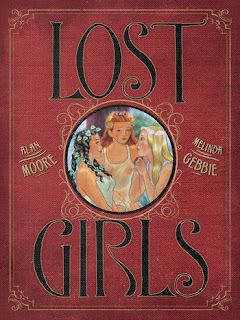
Lost Girls, Neither Coming nor Going


It’s been several years since I first read Alan Moore and Melinda Gebbie’s porn cum art comic Lost Girls. A potentially scandalous work, I overcame my wariness over its controversy with a trust that reflected, at the time, my relative alignment with the popular assessment of Moore’s work. Since then, however, I find myself more of a dissenting voice, questioning not the intelligence and knowledge Moore clearly brings to his writing but his often-overwrought craft in service of a muddled vision that brooks no criticism. Erudition should be an invitation to share a journey of discovery, not a wall that demands people prove themselves worthy to enter the ivory tower – a distinction Moore’s work seems to have increasingly abandoned.

Fundamentally, the problem I see in his work is a common one among writers; the tendency to thrust more ideas into a story than is necessary and meaningful. For Watchmen, it’s Moore’s inclusion of the god-like Dr. Manhattan that undermines an otherwise nuanced critique of the era’s prevailing mood of superhero worship and a study of the morality of power via the mythologize of costumed vigilantes. As a self-proclaimed puppet able to see the cosmic strings, Dr. Manhattan serves to establish a strictly deterministic universe in which all actions are predetermined and free will, along with the moral accountability that comes with it, is an illusion. Whatever critique of superheroes Watchmen can offer is, on its own terms, impossible given the characters’ lack of agency. After all, what morality can wind-up toys have? The layering of a free will vs determinism debate is too much for the story to bear, especially when Dr. Manhattan is the only character to grapple with it.

But Watchmen is a model of lean storytelling compared to the League of Extraordinary Gentlemen books, orgies of literary references, tangents, pureed concepts, metafictional wankery, pastiche fetishes, and an unpleasant penchant for the lurid that arrive nowhere if the standard involves meaningful characterizations and relatable narratives. The Illuminatus! Trilogy by Robert Shea and Robert Anton Wilson, which predates League by about 25 years, remains to me the quintessential model of how to tell philosophically provocative and meaningful, yet entirely gonzo, post-modern meta-stories. League, while admirable and often clever in both ambition and grasp of literature, comes across as posturing in comparison.

These excesses stand out to me precisely because of those works in which Moore does display the focused storytelling of a masterful writer with keen insights to offer in his characters, plots, and narrative themes. The first is V for Vendetta; a suspenseful and satisfying political thriller infused with a deliciously provocative ideological perspective. Words and images complement each other beautifully to deliver an outstanding example of what comic book storytelling can be. The other is From Hell, Moore’s provocative metaphysical meditation on the horrors of the 20th century as ritually presaged by Jack the Ripper’s murders.

So what of Lost Girls, Moore and wife Gebbie’s ambitious attempt to bring together art and pornography into something that could, in the mating, transcend both? The book is premised on a chance encounter between three characters extracted from classic children’s literature – Alice, Wendy, and Dorothy – at the posh Austrian hotel Himmelblau shortly before the onset of World War I. The narrative hasn’t even begun to undress when, alas, Moore’s tendency for excess shows itself. It happens in a conversation between two inconsequential servants who, in Moore’s process of hinting at Alice’s libertinous character, reference an unseen black character using the “N” word. The word is not only jarring, but entirely gratuitous since the book doesn’t deal with racial issues and is populated entirely by white characters. The first question that comes to mind is: do we really need a scruffy old white guy carelessly and pointlessly bandying racially charged words just to prove whatever notion of authenticity he harbors for his work – in a narrative fantasy? Next is: should we start questioning why Moore is so fixated on English and American literature, with nary a look outside of white borders?

Moving on to the broader thematic excesses, Moore’s decision to reference World War I is hard to reconcile with the overall erotic goals of his fantasia. Other than some passing references, particularly through the transient character of a convalescing soldier, Captain Rolf Bauer, the specter of war only haunts the narrative when readers remember it. Until the end, that is,  when it seems as if Moore suddenly remembers what time period he set his story in, at which point the most he can muster are banal musings on how much better it would be for the young men to be home having sex rather than fighting/dying, along with a final sequence of panels depicting an eviscerated soldier on the battle field. When the post-orgasmic glow of an erotic story comes from artillery shells rather than sex, something’s gone awry with the storytelling.

While to my eyes Moore has a tendency for overworking his sentences to the point of making H.P. Lovecraft look like Hemingway by comparison, even when he’s consciously aping classic authors, Lost Girls suffers more from his need to provide a running commentary, dialogue, or some kind of verbiage on every panel instead of trusting Gebbie’s artwork to excite readers. The lack of balance between words and images is particularly unfortunate in the story’s flashbacks, patterned in the broadest sense from Alice in Wonderland, Peter Pan, and The Wizard of Oz. Because Moore has Alice, Wendy, and Dorothy narrate their life stories, essentially explaining what Gebbie illustrates, most of the book’s characters don’t benefit from a voice, and therefore personality, of their own. Moore essentially locks us into the women’s interpretation of events through their narration, instead of allowing dialogue and images to guide readers to their own understanding of the pivotal moments in the lost girls’ lives. There’s so much writing that one wonder why Moore bothered with a graphic novel format for the story he wants to tell. The book’s limp drama is all the worse given that, for all the writing, Moore fails to create relationships that evolve throughout the course of the story. A notable example is between Wendy and her husband, the condescending and chauvinistic Harold Potter with whom marital bliss is tragically lacking. One would hope that with Wendy’s sexual escapades and Harold’s eventual indulgence of his repressed homosexual urges, each character might learn something to lead to some kind of change in themselves and their relationship to each other. But no. Harold remains every bit the condescending paternalist by the time he drives out of the plot; he and Wendy never even have a conversation to reflect on the meaning of their experiences. The lost girls themselves are similarly deprived of any depth of relationship to each other, since Moore requires very little to get them fucking each other and sharing their life stories. Whatever healing they arguably gain from recounting their trauma-laced sexual comings of age doesn’t lead to anything. For a book with literary aspirations, Lost Girls is curiously dry when it comes to character development. Like a burlesque dancer who comes on stage without any clothes on, and thus no means to tease and tantalize the audience, there is no buildup and release in Moore’ storytelling.

While the above shortcomings provide more than enough interruptus for the book’s coitus, it’s the depiction of child and teenaged sexuality that looms largest over the entire project. The controversy is arguably exaggerated, partly because Moore and Gebbie are not the first, nor the most boundary-pushing, artists to engage the topic, but also because in a book’s storytelling isn’t in service of gratuitous titillation. While there’s no accounting for how readers will personally react, the most questionable panels are generally a minority in a book that is, essentially, cover to cover sex mostly between adult characters. And violence, while implied in a few rare instances, is never depicted. So what, exactly, are Moore and Gebbie doing? The youth sexuality is presented in two ways. First is methodological, in that the story concerns three women’s life stories from the perspective of their sexuality, which means consistent explicitness for them as both youths and adults. There is context, biography, and characterization to what Moore and Gebbie offer, regardless of my view that it ultimately doesn’t amount to very much. Second are the short story pastiches, presented as excerpts from a scandalous little white book the hotel owner makes available to every guest in their rooms. A few of these pastiches consist of big, happy, incestuous, all-age family orgies that are so ridiculous and over-the-top, the impression is neither serious nor erotic but, intentionally or not, hilarious.

From here we get to the point of the book, the climax of its project that serves to pre-emptively defend their choice of methodology and subject matter from criticism. Through the character of Mr. Rougeur, the Hotel Himmelblau’s owner and the coy author of that little white book, Moore makes his argument during the grand orgy that caps off the story:

“You see? Incest, c’est vrai, it is a crime. But this? This is the idea of incest, no? And then these children: how outrageous! How old can they be? Eleven? Twelve? It is quite monstrous … except that they are fictions, as old as the page they appear upon, no less, no more. Fiction and fact: only madmen and magistrates cannot discriminate between them.”

To underscore the point, the not-entirely-reliable Mr. Rougeur says this right before observing that he is having sex with a thirteen-year-old. And thus, Moore believes, the trap is set: what, exactly, is there for readers to be morally outraged about? There is no reality, no action, no person to point to. Nothing, indeed, is actually happening, except as a mental fiction, an interpretation of words and images on the page.

But the trap is far from shut, not the least because Moore isn’t offering a new argument. Horror creators have long pointed to the fictional nature of their work as a moral bypass for the extreme violence and suffering they depict. And as long as there have been artists, there’s been a struggle over what constitute acceptable artistic subjects – with sexuality, of course, being a common flashpoint of censorship efforts. While there will always be debates in this area given a pluralistic society, particularly over where the boundaries of tolerance are drawn, the notion of freely exploring ideas even in light of their relative ability to offend is for the most part accepted and settled in liberal environments. Besides, what is pornography or it’s more refined sibling, erotica, if not the exploration of fantasies both attainable and unrealistic? It simply isn’t clear with whom Moore is arguing with.

Moore presenting an old argument to an outdated problem is unfortunate enough, but all the more so because it means he misses the opportunity for more interesting and relevant questions. The issue, really, shouldn’t be what responsibility reality has toward art, but what responsibility art has toward reality. It’s a matter of psychology and the role of fantasy in our mental health. While I wouldn’t argue that fantasy is necessarily bad, Moore’s declaration of support for an amoral mental playground neglects how thoughts influence our emotional states and patterns of behavior. Pornography, like reality TV, can warp our understanding of reality and can, without a skillful mindset, lead to harmful consequences in terms of body image, performance expectations, relationships, and related expressions of sexuality. When combined with mainstream cinema’s tendency to associate sex with menace (i.e. in thrillers and horror) or embarrassment (i.e. in sex comedies), our cultural understanding of sexuality tends to be more debilitating than liberating. Rephrasing the question, then: how can the art of sex help us enjoy our sexuality with skill and empathy in our day-to-day reality? Unfortunately, Moore doesn’t even offer a rationale or exploration for his declaration via Mr. Rougeur, so Lost Girls is certainly not positioned to explore any other questions.

Whether, despite all that, Lost Girls is of the one-handed or two-handed persuasion isn’t for me to say. It’s different strokes for different folks, and there’s enough variety for at least some panels to achieve some kind of effect. That said, I found the book to be singularly lacking in joy. The WWI context contributes to the downbeat impression, but really it’s Moore’s decision to retell whimsical stories as personal traumas that makes the book more cold shower than hot fling. For Alice, the journey to Wonderland beings with a  sexual assault by a family friend, and continues with her upbringing in an all-girls boarding school from which she falls in with a lesbian dominatrix, becomes addicted to opium, and is subjected to all manner of sexual debaucheries and twisted power games. Wendy’s experience involves her encounters with Peter Pan, over which looms the threat of a sexual predator nicknamed the Captain, a plot whose resolution leaves Peter a prostitute and Wendy sexually repressed. Of the three, only Dorothy has a less brutal retelling, in that after discovering herself during a tornado she merrily fucks her way through farmhands inspired by the Cowardly Lion, Scarecrow, and Tin Man, before moving on her father the Wizard. Other than a devastated stepmother, Dorothy is the only lost girl to emerge relatively unscarred from her teenaged experiences.

Not only is this grim stuff, glibly exploited, Moore’s decision also undermines the sexual freethinking he claims to support by resorting to unfortunate cliches, from Harold Potter’s latent homosexuality expressed as male chauvinism to Alice’s maturation into lesbian as reaction to a man’s sexual assault, immersion in an all-female environment, and drug-induced mental flights of fancy. He and Gebbie don’t get caught up in obsessions over body types and sizing, but that was the least they could do. And just as Lost Girls disappoint in terms of LGBTQIA+ allyship, it does nothing to alleviate the concerns raised by Moore’s questionable record in handling instances of sexual violence, from The Killing Joke to the Invisible Man’s crimes and punishment in League of Extraordinary Gentlemen.

Furthermore, Moore’s retelling of Carrol, Baum, and Barrie’s stories amounts to an act of artistic bad faith given his habit of complaining about people using his characters in follow-up works, such as the Watchmen prequels and sequel, while having made a career appropriating other artist’s characters for his own purposes. (Watchmen repurposed old Charlton Comics characters in the form of substitutes. Neonomicon and Providence directly H.P. Lovecraft’s stories. League of Extraordinary Gentlemen, of course, steals from everyone.) The outcome is a book that doesn’t engage with the original works, but appropriates and replaces them with little opportunity to deepen one’s interpretation of both. By comparison, look at how American McGee’s Alice games engage with Carroll’s books as a dialogue. Interpreting the books’ Wonderland as Alice’s healthy, childhood mental landscape, the games act as sequels exploring what happens when personal and social trauma warp Wonderland’s whimsy into gothic horror with Dickensian overtones.

Having read Lost Girls three times, with diminishing returns, the fact that there is much to write about isn’t a measure of how rich but rather how disappointing the book is. With that, the final word belongs, actually, not to Moore’s writing but Gebbie’s illustrations. Though a bit static and low-energy, her storybook style is nevertheless beautiful and inviting, explicit but not anatomically obsessive. I’m not the first to point out the cleverness she often displays in her panels, such as the sequence in which shadows frolic to emphasize the actual frigidity of Wendy and Harold Potter’s marriage. Also admirable is her ability to change her style to suit the various pastiches splashed throughout the narrative. While I don’t think her art is enough to compensate for Moore’s writing and storytelling – a comic’s success rests, as I mentioned, on the balance of words and images – that’s where the book blossoms best, when it blossoms at all. And with that, I’m perfectly fine with saying that I’ve reached the end of the daisy chain when it comes to Moore’s work. If nothing else, Lost Girls motivates to discover other artistic voices.

25.5.17

What Possessed the Filmmaker? An Interview with Sixto Melendez (Part 2)


For part 2, independent filmmaker Sixto Melendez and I look back to the good and bad of filming a feature film, and forward to the future. Click here for part 1.

What was your most challenging day while filming The Conduit, and how did you overcome it?

Through some connections in the town of Globe, AZ, where we shot 90% of the film, we were allowed use of a conference room in a local hospital for a couple of days. The plan was to shoot two different scenes that occur at different places in the narrative during the movie. One takes place earlier in the film and the other is non-consecutive and takes place much later in the film. The scenes involved group therapy sessions where our troubled protagonist meets his opportunistic antagonist and their lives become connected. Anyway, we had our cast, a number of extras. Among our cast we had an actress playing the therapist that was leading the sessions. Well, the first scene went off without any major issues of note and we got it "in the can" as we filmmakers say.

However, when we went back to shoot the second scene, the actress who played the therapist on the morning of the shoot informed us that she would not be able to get back to Globe from Phoenix where she was from.

We jumped through a number of hoops to get use of the hospital conference room and we knew there was no way we'd be able to arrange for another day within our schedule. The clock was ticking and we were playing phone tag with this actress, begging, pleading, crying, stressing out but at the end of the day we finally had to accept the fact that she was not going to make it. We were about to lose the day and our only option was to replace her, but we had already shot her in the other scene so we would potentially have to re-shoot that scene as well, which would have been impossible. It wasn't just getting the hospital location but also coordinating all of the extras who had already been shot in the previous scene.

After much stressing and time lost, we finally decided to move forward with another actress that we found on extremely short notice. As for the continuity of the two scenes with different actresses playing the therapist … I simply chalked it up to the notion that this is an ongoing therapy group that meets regularly and will often have different therapists in the lead.
I think I got an ulcer just recalling this.

Conversely, what day was the most fun?

It was a while ago, but one night stands out in my mind as particularly exciting. We were shooting a small but pivotal scene where our protagonist Eddie (played by Wes Martinez), after much difficulty and confusion, finally turns to the mysterious character Gabriel (played by Mike Watkiss) that has been stalking him for answers. In the scene, Gabriel enlightens him on the mysterious backstory of the femme fatal who is tormenting him.

The scene was very small and simple. Just two characters, one small room, and a broken down shed where the character Gabriel lives. We had a very small skeleton crew, just me directing, Javi our DP, and Eric our sound recorder.

As writers we put word on the page, describing the images we see in our minds as we try to convey a narrative to the viewer. Our minds can fool us sometimes because what we are trying to express is clear in our minds so while it makes narrative sense to us in our own heads, what we put on paper and eventually on the screen doesn't always translate as you imagined.

However, when it does and when two of your strongest actors begin to deliver a scene and the chemistry between them is working and the scene is already working and coming to life right before your eyes, before you've done any of the cutting or sound design, or color grading or any of the post effects that you will eventually add, there's just an amazing, fulfilling sense of gratification that I wish I could bottle and sell.

Sometimes when you're shooting and everything is just falling into place, the actors are delivering, the crew is functioning smoothly and things are going as they should – you can already sense it working. Rather than hearing the voice in your head ask "Will it cut together?" the voice actually changes and says "I can't wait to cut this together!" Because you just know that it's working and you're capturing a moment.

Shooting this scene was one of those special moments that I'll always treasure.

Now that The Conduit has been released, I assume you're conceiving your next film. What are you thinking about doing next?

I have an idea that I'm kicking around, but it's a pretty deep spiritual idea that I have not quite found my path with yet. So, I don't want to divulge too much. It has to do with altered states of consciousness and a spiritual quest seemingly gone awry. I need to have an altered state experience before I will allow myself to write a script because I do believe in writing what you know, or at least have enough experience or good research to speak with some level of understanding and not just dream things up.

If money was no object and you could choose any actors/actresses you wanted for your cast, what would be your dream film to make?

The idea that I mentioned above is a one that I would love to see developed and executed with a real budget as opposed to the shoe-string on which we made "The Conduit". I'm taking lots of notes and compiling my thoughts at this time but I am not ready to tackle the script just yet. Although I am getting close to possibly starting a rough treatment.

In my head, I imagine Jake Gyllenhaal in the lead. I've been drawn to him as an actor since Donnie Darko, and this idea that I am kicking around is similar in that it deals with cosmic mysteries. I'm not sure what it is about him. He's definitely a solid actor but there's an everyman quality about him that I appreciate, especially for a character like this. A grown man able to make his own choices yet on some level young enough to make the wrong choices. I'm not sure if that truly sums up the qualities I like about him but at the moment that's what comes to mind.

And honestly, if I found myself on a set directing Jake Gyllenhaal, I would have to take a moment to revel in the moment because he's definitely an A-list movie star, so if ever I'm lucky enough to find myself in that situation I'll be able to say "I made it."

For now, it's nice little fantasy. It's important to dream.

###

Watch the trailer for The Conduit here:


And to buy the Conduit, visit Brain Damage Films.

Thank you for reading. If you enjoyed this article, please consider sharing it via your favourite social media, leaving a comment below, and signing up to receive new posts by eMail. 

What Possessed the Filmmaker? An Interview with Sixto Melendez (Part 1)


It’s always a pleasure to discover and promote independent talent in the arts, especially since they don’t benefit from the huge marketing budgets of Hollywood studio productions. So by way of his short film Laberinto Infernal, let me introduce to you to Sixto Melendez, who just completed his first feature film, The Conduit.


And now on to part 1 of our interview…

I understand that personal experience plays a big part in your storytelling. What experiences inspired your new film, The Conduit?

I've always been terrified and fascinated by the concept of demonic possession. The idea that some alien entity can enter your body, suppressing your essence, soul or whatever it is we believe comprises us beyond our physical bodies and take the wheel is absolutely terrifying. But it's like a train wreck, as scary as it is you can't look away. I can't, anyway.

I remember being a kid and discovering the novel for "The Exorcist". I must have been 10 or 12. It was beat up old paperback that someone, maybe my older brother or sister, had brought home. I was reading this terrifying novel and it was getting under my skin. I remember my mom hiding it from me when I had trouble sleeping. I would lay in bed thinking about it and my heart would race and I swear it felt like the bed was shaking, which scared me further, increasing my heart rate which only made it feel like the bed was shaking harder.

It was a powerful curiosity based on the fear of knowing that while some people chalked it up to superstition many others truly believe that this is real and if it is real, well, then there's the mystery of why? Who is susceptible? Can it happen to me? That kind of thing in the naturally creative mind of a child led to long nights staring into the darkness and listening to the silence.

Sixto Melendez
I also did have a short spell in my early 20's where I personally experienced sleep paralysis. It happened about 4 or five times in the span of about 5 or 6 years. I just remember slowly drifting to consciousness from a deep sleep. Being aware of my surroundings, perhaps even seeing the room through partially open eyes but not being able to move. My body felt like lead. I didn't know if something was wrong with me physically or if something was happening to me in a metaphysical, spiritual sense but it was exasperating. It was a panic that I can't properly convey. You can't imagine what being perfectly aware yet not having control of your body is like unless you experience it.
Of course, my first thought was that something was trying to possess me. I mean it's human nature to jump to the absolute worst-case scenario conclusion. Which is interesting because when I finally looked into it and found that there actually is a recognized, documented condition called sleep paralysis. I then learned that, in the middle age, when people experienced this they, too, drew the same conclusion that it was an early stage of demonic possession.

The book, the movie, the experiences the concept became part of the fabric of my existence. Something I would always return to. Somewhere along the way I learned about the concept of demonic transgression. The idea that an attached demonic entity could be passed from one person to another and that led to the idea of comparing demonic transgression to a sexually transmitted disease. Imagine passing a demon to a lover like a really evil herpes! I loved the idea and had to explore it.

How would you describe your storytelling process?

For me the creative process is a struggle that requires too much effort for me to just "like" an idea. I need to be obsessed with it on order to see it through. After that it's a long slow process of kicking an idea around, taking notes, reading books or whatever material I can find on the subject, studying movies and whenever possible actually experiencing the subject matter as closely as I possibly can in order to understand it enough to where I don't feel like I'm just spewing bullshit. Often times my friends and creative partners will throw ideas at me about film topics. While they are often very interesting ideas that would probably make great movies, if it doesn't intrigue me personally, I can't commit.

Which all comes from my love/hate relationship with writing.

If the idea is crystal clear in my mind. If I know my story and my characters and where everything is going, I absolutely LOVE writing. It's so gratifying to take this idea from within my head and put it on the page, giving birth to it and making it so that others can take the ride. It's a wonderful experience when the idea is ready and when I'm ready to tell it.

But if the idea is half baked, if I still have questions or the narrative is unclear, I absolutely DETEST writing. I'd rather have a root canal than sit at a computer trying to dream up a story and so for that reason, I don't write much. I scribble notes. I have two physical notebooks filled with stuff. Concepts, scenes, characters. I collect and compile as I ponder my concept. Sometimes for months. Sometimes a year will go by or longer before I feel confident enough that I know my story well enough to bring myself to sit down in front of the computer and put words on a page.

How different was your approach to conceiving and producing/directing a full-length feature film compared to your previous shorts?

The process was not really that much different other than as one would figure with a feature everything is just a little more of the same. You have to research a little more because you're going to develop your story and characters to a greater degree than you would in a short. So essentially it's the same, just on a bigger scale. You research more, you develop further creatively, you produce more because you're going to shoot more, everything translates to just a bigger version of the same things.
The problem I found with this was that while this translated in many respects from writing to pre-production, the one area where it really hurt us was during actual production –  and that was due to simple human limitations of stamina. Often times when you make a short film, a group of friends will get together for a weekend or two on their days off and engage in the fun and sometimes exhausting process of shooting a short film. You easily push past an 8 hour day carried through by the excitement of the simple fact that you are working on a passion project. Something you love doing so that carries you past the exhaustion of 12 or 14 hours of working on the project. It's easy when you're shooting on a weekend or two. You know that if you just hang in there for a little longer, you'll soon be able to rest and recuperate and you'll have a hopefully wonderful little film for all your efforts after pushing through.

While it's easy to push the boundaries of stamina for a weekend, it becomes extremely exhausting when you wind up pushing the boundaries for weeks on end. I remember a number of times getting home filthy, exhausted and on the verge of tears due to the hoops we just had to jump through. You make a plan, you set things in place, you move your team and gear into place, you get started and then any of a million unexpected things will happen and your carefully laid plans are slowly coming undone. So, you learn how to deal with the stress of having things fall apart as you try to salvage them to the best of your ability. But you push on.

Stay tuned for Part 2.

Thank you for reading. If you enjoyed this article, please consider sharing it via your favourite social media, leaving a comment below, and signing up to receive new posts by eMail. 

24.2.17

losing it in La La Land


La La Land is one of those movies that can’t possibly mean what it says, no matter how much marketing and overheated critical acclaim might wish otherwise. The last such movie I can think of that similarly blinkered audiences was Pan’s Labyrinth, Guillermo Del Toro’s exquisitely crafted cinematic work that posed as an anti-fascist parable but ultimately affirmed a nihilistic preference of fantasy over reality. It could have been a film about imagination’s power to inspire action against oppression. Instead, its final shot casts an escape into a fairy tale world as the reward for a child’s suffering and sacrifice. What Nietzsche wrote about Christianity applies well to Del Toro’s fairy tale: “Christianity was from the beginning, essentially and fundamentally, life's nausea and disgust with life, merely concealed behind, masked by, dressed up as, faith in "another" or "better" life.”

But Pan’s Labyrinth, at least, is diminished by a philosophical error that can be overlooked given how otherwise magnificent it is as a film. La La Land, for all the effervescence of its sensational score or the chemical reaction of Ryan Gosling and Emma Stone, is illusory in almost every aspect –  and has nowhere near the craft of a Pan’s Labyrinth. Although presented and structured as a romantic comedy, the film proves itself the opposite of romantic. Romance presupposes a commitment to love, whether it’s the love that conquers all, as comedies would have it, or love worth suffering and dying for, as the tragedies declare. “Love is the drug,” as Roxy Music puts it. La La Land initially plays the melody of a romantic comedy – unlikely couple meet and fall in love – but ends on a melancholy note of regret over the path not taken. (Woody Allen purposefully explored the same theme in Café Society with greater focus and emotional heft, despite a similar tendency to trade in clichés and hackneyed insights.) The turn towards the bittersweet feels like a wrong note in La La Land. Partly because it’s tacked on with a 5-years-later epilogue, but mostly because writer-director Damien Chazelle splits his leads – a jazz pianist who dreams of owning his own nightclub and an aspiring actress struggling for her big break – for the flimsiest reason: an inability, or unwillingness, to reconcile their relationship with their career dreams in a situation where no sacrifice is necessary. We can interpret it in two ways: either they choose their careers at the expense of their relationship, or the film manipulated the scenario so that pursuing one’s dream requires sacrificing love. Neither option is romantic; romance is understanding that one’s dreams are best achieved when the journey is shared with the people we love.

The other deception La La Land foists on audiences is that it is an homage to Los Angeles in general and Hollywood in particular. But Chazelle, who hails from the East Coast, falls into a common trap when trying to make a character out of a city like LA: equivocating the distinct character of specific places with the persona of the whole. Sure, La La Land opens with the familiar cliché of LA’s notorious traffic, then graces us with scenes at the iconic Griffith Observatory. But LA is not defined so much by places then the connection between places. Films like Swingers and LA Story understood this, and remain even today insightful portraits of a sprawling metropolis and what it’s like to live in it. La La Land, however, retreats into advertising a tired Hollywood promise: work as a barista and fruitlessly audition for parts long enough, and maybe, by chance, you’ll meet the right person at a party or casting call who’ll give you that almighty break. The Hollywood Dream, brought you to by the Golden State lottery.

Here’s the thing: if it’s a film about the magic of movies you want, Michel Hazanavicius delivered it a few years ago with The Artist, an imaginative and quintessentially cinematic revival of the silent film that also succeeded in actually being romantic. So did Martin Scorsese with Hugo. And if it’s Los Angeles you want, the aforementioned Swingers and LA Story are worth revisiting. As for romance, there’s no shortage of films to inspire all the lovers in the world.

Yet for all that La La Land really amounts to Hollywood loving itself, it’s an enjoyable revival of the movie musical –when we stay on the surface. The song-and-dance numbers are energetic and captivating, beginning with an opening scene on a gridlocked Los Angeles highway with happy motorists demonstrating that we’re about to watch a fantasy. Ryan Gosling and Emma Stone succeed in creating genuine characters we become vested in, even if Chazelle ultimately undermines them. La La Land isn’t Best Picture material but, with the understanding that this isn’t a romantic comedy, it isn’t a total write-off either.