


20.5.13
massaging the medium with marshall mcluhan (at TFPO)


14.5.13
a crash course in corporate profiteering
Strictly in pop-political terms, it seems as if conservatives are generally in favor of corporations but suspicious of government (aka the deregulated "free market"), while liberals are suspicious of corporations but in favor of government. Although the evils of government are easy to list, it is often too easy to forget the good that government can do, such as roads and social safety nets. Nevertheless, the ability of the private sector to fulfill the public-good functions of government is a powerful ideology. And that ideology fails to take in account situations such this one, recently reported by the Associated Press:
AP IMPACT: Cars made in Brazil are deadly
It seems that Brazil has four times the fatalities in passenger car accidents than the US, and the problem is "the cars themselves, produced with weaker welds, scant safety features and inferior materials compared to similar models manufactured for U.S. and European consumers, say experts and engineers inside the industry. Four of Brazil's five bestselling cars failed their independent crash tests."
Carmakers, of course, claim their cars meet Brazilian safety laws, although "the country's few safety activists perceive a deadly double standard, with automakers earning more money from selling cars that offer drivers fewer safeguards." They might, indeed, be following the law...and if that law happens to result in considerably less safety than, say, US law...well, tough luck for Brazilian drivers, right? Caveat emptor.
The lesson is that, when left to their own initiative, it is all-too-easy for corporations to choose profit above people and the environment. Examples such as this highlights the fact that corporate authority is something to be wary of just as much as government authority, a position that ultimately rejects the doctrinal positions of both pop-conservatism and pop-liberalism, as well as refutes libertarianism as fundamentally misguided (read: fatally flawed) anarcho-capitalism. Ultimately, the problem is an age-old conundrum. Just as there is good governance and bad governance (in the moral sense), there is good business and bad business. The difference between the good and the bad is, of course, people.
10.5.13
Can Baggers Be Choosers? (at TFPO)
Culver City's City Council will vote on Monday on whether or not to ban plastic bags. Naturally, it has created quite the debate. Here's a round-up of op-ed pieces at The Front Page Online, culminating in my own contribution:
And mine:
If nothing else, the proposed ban on plastic bags has ignited a much-needed public discussion on our environmental impact, with a focus on two issues: Public health and resource management. The most pressing question that arises is this: Do you wash your underwear?
Read the rest here: Can Baggers Be Choosers?
What do you think? To ban or not to ban?
- Plastic Bag Bans Are Killing Californians, It Says Here by John Kuechle
- It’s in the Bag – That Is What City Hopes Plastic Bag Ban Is and Hopefully, the City Council Will Be as Wise as San Clemente’s by TFPO's editor, Ari Noonan
- Single-use Plastic Bag Is Far More Practical by Goran Eriksson
And mine:
If nothing else, the proposed ban on plastic bags has ignited a much-needed public discussion on our environmental impact, with a focus on two issues: Public health and resource management. The most pressing question that arises is this: Do you wash your underwear?
Read the rest here: Can Baggers Be Choosers?
What do you think? To ban or not to ban?
6.5.13
heeeeey margarita!
Cinco de Mayo has come and gone, but a good margarita recipe lives forever. I've been struggling over the years to come up with the perfect, or near-perfect, go-to recipe for a classic margarita - the kind I can just pull out of my cocktail book, mix up, and not worry about.
Although I've come up with interesting variations, like a pineapple-guava margarita, the classic eluded me. So I tried looking online for an alternative to the book I had so far been using, and came across a simple recipe that used tequila, cointreau, and lime juice in a 3:1:2 ratio.
It didn't work.
So with my wife's far superior palate as final arbiter, I heavily modified the above recipe to come up with a margarita that has all the flavour I expect: Sweet, but not cloying, with ever-so-slightly dominant citrus notes, and a finishing jab wearing padded gloves.
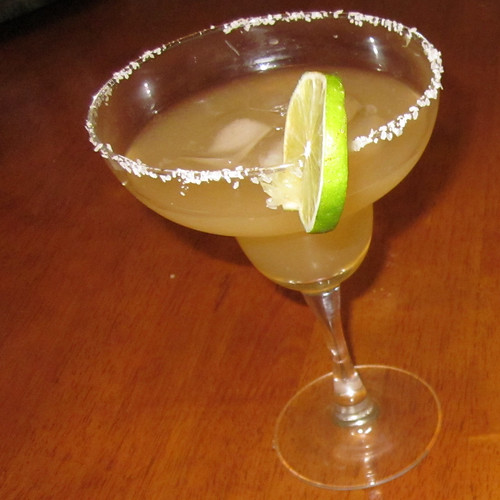
The right tasty result:
Although I've come up with interesting variations, like a pineapple-guava margarita, the classic eluded me. So I tried looking online for an alternative to the book I had so far been using, and came across a simple recipe that used tequila, cointreau, and lime juice in a 3:1:2 ratio.
It didn't work.
So with my wife's far superior palate as final arbiter, I heavily modified the above recipe to come up with a margarita that has all the flavour I expect: Sweet, but not cloying, with ever-so-slightly dominant citrus notes, and a finishing jab wearing padded gloves.
The right tasty result:
I call it the Social Margarita, because the quantities are intended to yield two servings for sharing.
You will need:
- two margarita glasses
- cocktail shaker
- ice
- salt (optional)
- lime wedges or slice
- 3.75 oz of tequila
- 1.5 oz of grand marnier
- 1 oz of BOLS triple sec
- 2 oz of fresh lime juice (or juice that is not from concentrate)
Wet the rims of the glasses with the lime slices, than salt as desired. Pour in the mix with the ice, and garnish with a wedge or slice of lime. Finally, enjoy.
Give it a try and let me know how it turns for you. Just remember: margarita recipes are very personal indeed. If this one doesn't do the trick for you, experiment and share your results with me!
Salud!
Give it a try and let me know how it turns for you. Just remember: margarita recipes are very personal indeed. If this one doesn't do the trick for you, experiment and share your results with me!
Salud!
3.5.13
science fiction's forget-me-not (@TFPO)

Subscribe to:
Posts (Atom)